Mathematical Modeling
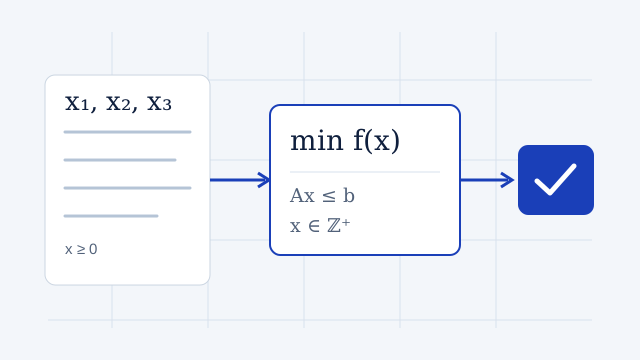
We translate how your business operates into solvable mathematical models. Supply chain constraints, market equilibrium, process dynamics: we build models that solve and return concrete decisions.
- check_circle Deterministic and non-linear programming
- check_circle Dynamic systems and control theory
- check_circle Economic modeling and game theory
Stochastic Simulation
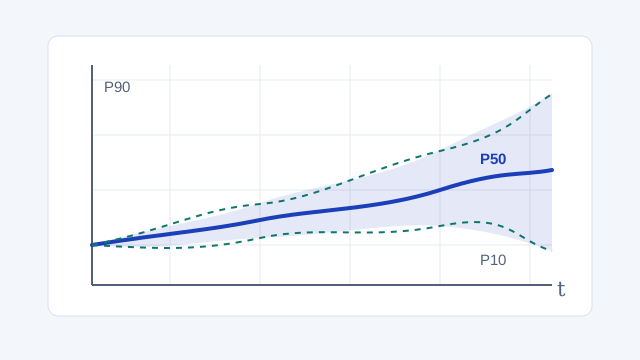
We model systems with uncertainty using Monte Carlo and discrete-event simulation (DES). Thousands of scenarios let you measure how your operations would perform before you implement a change.
- check_circle Monte Carlo Simulations and Markov Chains
- check_circle Risk quantification and sensitivity analysis
- check_circle Capacity planning under uncertainty
Process Optimization
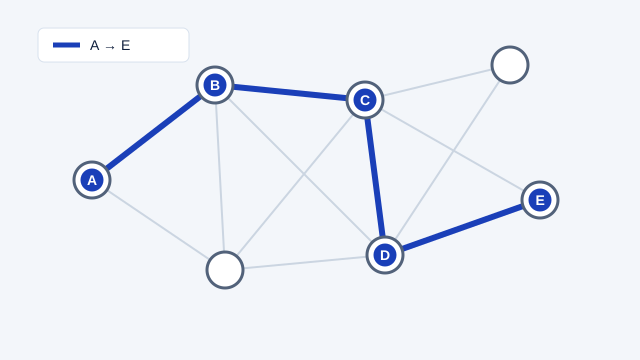
Find the optimal path. We apply advanced heuristics and exact algorithms to solve routing, scheduling, and resource allocation problems that are too complex for traditional logic.
Linear Prog.
Resource efficiency and cost minimization.
Combinatorics
Complex logic for scheduling and routes.
Machine Learning & AI
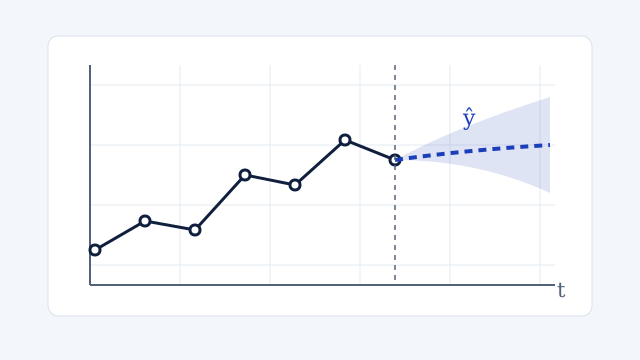
Beyond descriptive analytics. We design custom neural networks and predictive engines that learn from your historical data to automate decision-making and forecast demand with high accuracy.
- check_circle Deep Learning and Transformer Architectures
- check_circle Predictive Maintenance and Fraud Detection
- check_circle Reinforcement Learning for autonomous systems
Business Intelligence & Analytics
Data is only valuable if it drives action. We develop sophisticated BI dashboards that aggregate data from multiple sources into real-time mathematical insights for executive leadership.
- check_circle Data Engineering
- check_circle Custom Dashboards
- check_circle Real-time Reporting
Tailored Digital Solutions
Off-the-shelf software often fails against unique scientific or operational requirements. We build custom software tools, from desktop optimizers to cloud-native AI platforms.
- check_circle Custom API and Microservices development
- check_circle High-Performance Computing (HPC) solutions
- check_circle Secure data architecture for proprietary models
What is operations research? expand_more
It's the discipline that uses mathematical models to decide how to allocate limited resources: which routes to take, what inventory to hold, what shifts to assign, what products to make and in what quantity.
What sets it apart from descriptive analysis is that it produces a concrete decision. Some problems can be solved to the best possible answer in seconds, when rules are stable. Others are too large to solve exactly and need approaches that deliver good solutions quickly, without a guarantee of optimality. When real uncertainty is in play (variable demand, equipment failures, irregular delivery times), the goal isn't optimality: you propose a policy and measure how it behaves before applying it.
What is the difference between optimization and machine learning? expand_more
Machine learning learns patterns from historical data and answers what will happen: expected demand next quarter, the probability of equipment failure, a customer's risk. Optimization finds the best decision given an objective and constraints, and answers what to do: how many trucks to operate, what inventory to send to each distribution center, which order to accept.
In real operations they work together. A typical pipeline: ML forecasts demand per location over the next 14 days, and optimization uses that forecast to allocate inventory across centers and plan shipments. On its own, ML leaves the decision to a human who has to interpret the forecast; optimization without ML needs someone to estimate demand by hand.
Machine learning, artificial intelligence, and LLMs: when should you use each? expand_more
Large language models (LLMs) are AI models trained on huge amounts of text to understand and generate language. They're a branch of machine learning. A traditional predictive model is trained for a specific client task; LLMs come pre-trained with general knowledge of language and adapt to the business context through prompts or reference documents (RAG, retrieval-augmented generation).
They work well when the problem involves unstructured text: classifying emails, summarizing long documents, extracting information from contracts, answering questions about internal manuals, drafting first versions. In those cases an LLM replaces hours of manual work with acceptable results in seconds.
They don't work when the problem is numerical, structured, and has clean data. Forecasting demand, detecting fraud, optimizing inventory, or adjusting prices are better handled by classic predictive models or by operations research. Using an LLM for those cases is usually more expensive, slower, less accurate, and harder to audit.
What is stochastic simulation? expand_more
Stochastic simulation reproduces the behavior of an operational system over thousands of random scenarios to estimate how it responds to different policies. It's useful when uncertainty dominates: variable arrival times, unpredictable failures, demand with seasonality and noise.
Unlike optimization, simulation doesn't return the best decision. It returns the distribution of outcomes for a policy you propose: how much it costs to run with 5 trucks vs. 6, how many hours of queueing arise if arrival frequency shifts, what happens if a machine goes down one day per month. It works where other methods fail, but it needs enough runs to be statistically reliable and depends a lot on how well the input distributions are described.
What is a mathematical optimization model? expand_more
An optimization model describes a decision in three parts: what you want to achieve (minimize cost, maximize profit, reduce time), what you choose (quantities, assignments, routes, schedules), and the rules you can't break (available capacity, budgets, regulations, contractual deadlines). Solving it returns the combination of decisions that respects all the rules and best achieves the objective.
A concrete example: assigning 30 trucks to 200 deliveries minimizing fuel, subject to each truck operating at most 9 hours and each customer receiving within their delivery window.
The trade-offs are practical. Some problems solve in seconds when rules are continuous and well-behaved. Others take hours or days when there are yes/no decisions (open this warehouse?, assign this driver to that route?), because the combination space grows exponentially. When the objective or rules involve products between variables, guaranteeing the best solution is the most expensive of all.
What is business intelligence and how is it different from machine learning? expand_more
Business intelligence (BI) organizes historical data into reports, dashboards, and KPIs so people can make better decisions. Machine learning builds predictive models from that same data. BI answers what happened; ML answers what will happen.
In practice, BI is cheaper to build and easier to operate: SQL, data models, dashboards. ML has more reach but requires data quality, ongoing monitoring, and retraining. Most real operations use both: BI to monitor day-to-day and understand what's shifting, ML for forecasting, anomaly detection, and cases where explicit rules aren't enough.
What data does Lontra need to start a project? expand_more
We start with whatever the client has today. Each project has a different scope, but the most useful inputs at the start are usually the relevant operational history (transactions, orders, times, locations, inventory levels), the business rules (capacities, contracts, regulations, operational constraints), and the context of the problem you want to solve.
Formats are not a blocker: Excel, CSV, ERP exports, SQL databases, PDFs for rules and manuals. If the data is messy or incomplete, the first phase of the project includes structuring and validating it alongside the internal team; missing perfect data is rarely what prevents the work from starting.
What does Lontra deliver at the end of a project? expand_more
Every project ends with a working deliverable: a running optimization model, a simulator, a decision-support system, or a set of predictive models integrated with the client's systems. The handover includes documented code, validation against real client data, and a transfer session with the client's internal team so they can operate and maintain the solution without depending on Lontra.